


Being good at your job does not automatically prepare you to lead a business.
A finance manager may understand budgets and controls. An HR manager may know how to build capability. An operations manager may know how to improve efficiency. Those skills remain valuable as responsibilities grow, but senior leadership requires something broader: the ability to understand how decisions in one part of an organisation affect the whole.
That is where commercial awareness for managers becomes important.
For professionals preparing for director and senior leadership roles, commercial awareness means understanding how strategy, finance, people, customers and operations connect, then using that understanding to make better decisions.
The shift from functional expertise to business judgement
The move into senior leadership changes the questions you are expected to answer.
As a manager, you may be asked:
Is my team delivering?
As a senior leader, the question becomes:
Is what my team is doing helping the organisation achieve its wider objectives?
That is a significant shift.
A decision to reduce costs may improve this quarter’s figures but affect service quality six months later. Investing in technology may improve productivity, but only if employees have the skills and processes to use it effectively. Increasing headcount may improve capacity, but only if demand and revenue justify the additional cost.
Senior leaders need to understand these connections before making the decision.
Why commercial awareness matters in the UK business environment
The current UK economy gives managers little room to think about their own function in isolation.
The Office for National Statistics reported that its latest estimates show mixed productivity results. Its flash estimate for the second quarter of 2026 put output per hour 0.7% higher than a year earlier, while the Labour Force Survey-based estimate showed output per hour 0.2% lower.
The Bank of England’s July 2026 Monetary Policy Report also points to subdued underlying economic growth, weaker business confidence and pressure from higher energy prices and financing costs. Business investment is expected to soften as uncertainty and borrowing costs affect investment intentions.
For managers, these are not simply economic statistics.
They affect decisions about recruitment, investment, pricing, technology, suppliers, budgets and customer priorities.
This is why senior professionals need to understand what is happening beyond their own department.
Strategy only works when the business can deliver it
A strategy sets direction. Commercial awareness asks whether the organisation can afford, resource and execute that direction.
Consider a business planning a major technology investment.
The technology team may focus on the system. Finance will consider the cost and return. HR may need to assess skills and training. Operations will need to change processes. Customer teams will need to understand how the change affects service.
None of those perspectives is sufficient on its own.
The strategic decision comes from understanding how they fit together.
This is the difference between functional management and enterprise thinking.
A useful way to think about commercial awareness
STRATEGY
What are we trying to achieve?
↓
FINANCE
What will it cost and what value could it create?
↓
PEOPLE
Do we have the skills and leadership capability to deliver it?
↓
OPERATIONS
Can our systems and processes support it?
↓
CUSTOMERS
Will it improve the experience, value or outcome we provide?
↓
STRATEGY
Does the decision still support our wider direction?
The cycle matters because a change in one area can alter the answer in another.
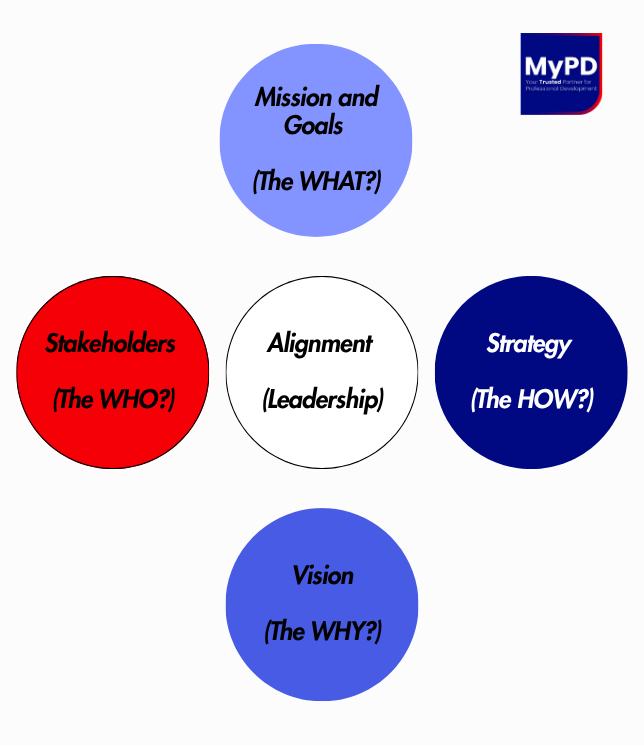
The questions commercially aware managers ask
Commercial awareness is not about knowing every financial term or becoming an expert in every business function.
It is about asking better questions.
What is happening outside the organisation?
Managers need to understand the factors that could change demand, costs, investment or risk.
The Bank of England’s latest business intelligence, for example, shows that low domestic demand continues to affect business services activity, while clients are delaying some decisions and focusing more closely on costs.
A commercially aware manager considers what these conditions could mean for their own organisation rather than treating them as someone else’s problem.
What does this decision cost beyond the budget?
A saving in one department can create a cost elsewhere.
Reducing training may lower expenditure but weaken capability. Cutting supplier costs may affect quality. Adding approval stages may reduce risk but slow down sales or delivery.
The right question is not simply, “What does this save?”
It is, “What is the total business impact?”
Where does the organisation create value?
Senior leaders need to understand what customers value, where revenue comes from, which activities generate returns and where resources are being consumed without sufficient benefit.
That means looking beyond departmental targets and understanding the organisation’s underlying business model.
Can we deliver what we are proposing?
A strategy is only as strong as the organisation’s ability to execute it.
Managers should be able to identify whether the organisation has the people, systems, finances and leadership capability required to turn an idea into results.
Commercial awareness in a changing digital landscape
Technology makes this broader perspective even more important.
The UK Business Data Survey 2026 found that 48% of businesses in the finance and insurance sector reported using AI. However, only 21% of businesses using AI said their tools were integrated into existing business systems.
That gap illustrates an important leadership point.
Buying technology is not the same as creating business value.
Leaders need to consider the process being changed, the people using the technology, the quality of the underlying data, the expected return and the risks involved.
The same principle applies whether the decision concerns AI, recruitment, restructuring, investment or cost reduction.
A quick test for managers preparing for senior leadership
Ask yourself:
-
Can I explain how my function contributes to revenue, cost, cash, customers or productivity?
-
Do I understand the main external pressures affecting my organisation?
-
Can I explain the financial implications of decisions outside my own area?
-
Do I consider the impact of a decision on other functions before recommending it?
-
Can I challenge a proposal by explaining its wider commercial consequences?
-
Do I understand what our customers value and how the organisation creates value for them?
If several answers are uncertain, the development gap may not be technical expertise.
It may be commercial judgement.
From functional expertise to wider leadership
Commercial awareness is one of the capabilities that separates a strong functional manager from a leader who can operate at director level.
Our Director Development Accelerator Programme is designed to help managers and aspiring directors make that transition.
Across five days, participants develop their understanding of directors’ responsibilities and governance, strategy, finance, marketing and leadership. The programme connects these areas rather than treating them as separate subjects, helping participants understand the wider responsibilities that come with senior leadership.
Participants can also work towards the CMI Level 7 Certificate in Strategic Management and Leadership Practice.
The goal is not to turn every manager into a finance, marketing or operations specialist.
It is to develop leaders who can understand the whole organisation, ask the right questions and make decisions with the wider business in mind.
Your next promotion may give you greater responsibility. Commercial awareness helps you develop the judgement to use it well.