


⌛ Read time: 5 minutes
Artificial intelligence is nothing new and is now part of everyday business activity. Employees are already experimenting with tools such as ChatGPT and Microsoft Copilot to write emails, summarise meetings, analyse data and support decision-making.
The challenge for senior leaders is: how to introduce AI safely, ethically and productively.
Without clear governance, businesses risk exposing confidential data, creating inaccurate outputs, damaging customer trust or introducing compliance issues before proper controls are in place.
The good news is that AI governance does not need to be overly technical or restrictive. With the right structure, organisations can adopt AI responsibly while still encouraging innovation and productivity.
Why Leaders Need an AI Governance Checklist
Many organisations are introducing AI informally. Staff are testing tools independently, often without guidance on acceptable use, security or accountability.
This creates several immediate risks:
- Sensitive company information is being entered into public AI tools
- AI-generated content containing inaccurate or biased information
- Unclear ownership of decisions influenced by AI
- Staff using AI without understanding legal or ethical implications
- Different departments are adopting inconsistent approaches
For directors and senior managers, the first step is creating a clear framework before AI use becomes widespread.
A practical governance checklist helps leaders move from reactive decision-making to a structured plan.
1. Define Why Your Organisation Is Using AI
Before selecting tools or writing policies, leadership teams should identify the business problems AI is expected to solve.
Focus on practical outcomes such as:
- Reducing repetitive administrative work
- Supporting strategic planning
- Improving customer response times
- Assisting with research and reporting
- Helping teams analyse information more efficiently
Avoid adopting AI simply because competitors are. Successful implementation starts with a clear business objective linked to measurable outcomes.
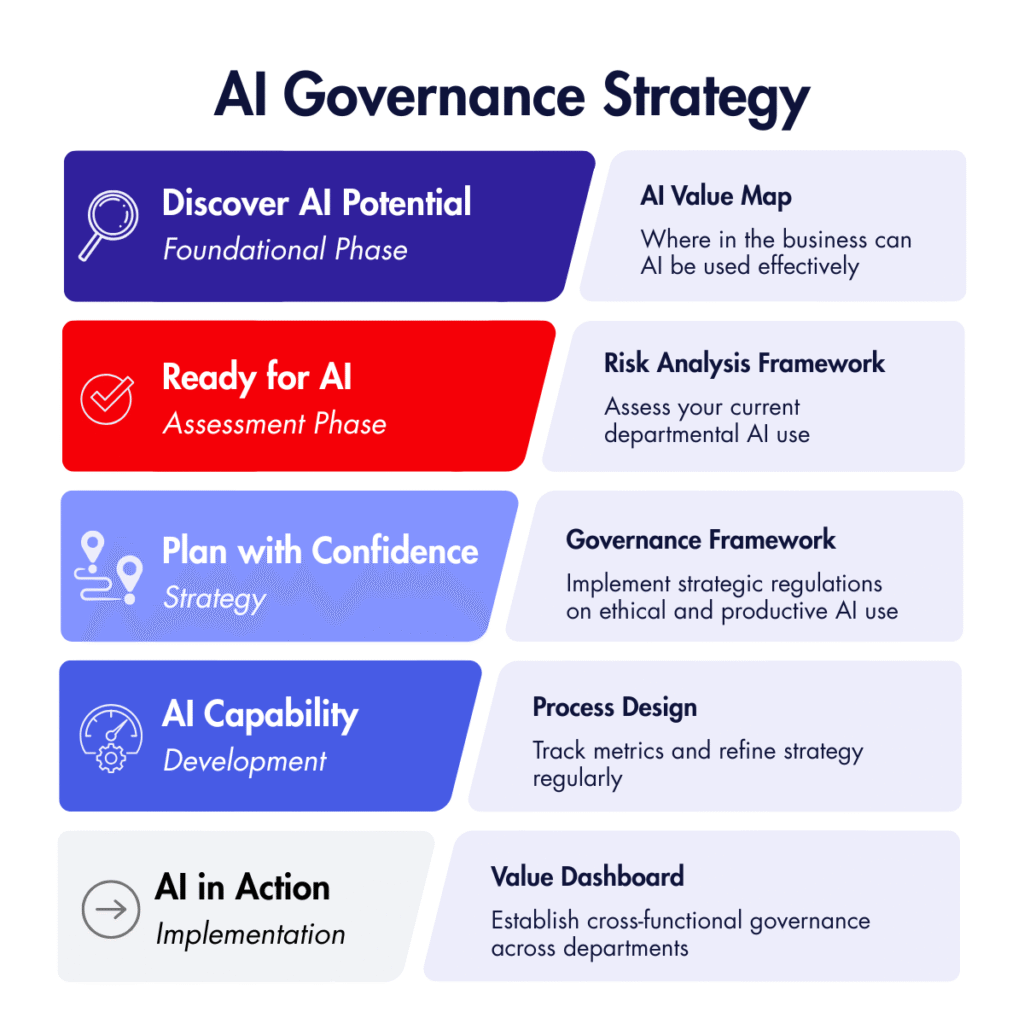
This approach is a central focus of the three-day AI for Leaders programme, where participants build an AI opportunity map aligned to organisational priorities. Awareness of the issue while investigations continue can buy valuable time without creating unnecessary risk.
2. Decide What Employees Can and Cannot Use AI For
One of the most common mistakes organisations make is allowing unrestricted use of AI without boundaries.
Leaders should establish clear guidance covering:
Acceptable AI Activities
- Drafting internal documents
- Research support
- Brainstorming ideas
- Summarising non-sensitive information
- Supporting marketing planning
Restricted Activities
- Uploading confidential client or company data
- Making fully automated decisions without human review
- Using AI-generated legal or financial advice without verification
- Processing sensitive employee information through public tools
Staff need practical examples, not vague warnings.
As Emma, trainer on the AI for Leaders programme, explains:
Sometimes it’s being used in what we call shadow AI use. So the leaders are not really sure who’s using it, how they’re using it across the organisation, and what risks are appearing from that usage. And they’re unable to make things like strategic decisions around policy, around security, around governance.
3. Put Human Oversight in Place
AI can support decision-making, but accountability must remain with people.
Leaders should ensure:
- AI-generated outputs are reviewed before use
- Employees understand AI can produce inaccurate information
- Important decisions are not delegated entirely to AI systems
- Teams know who is responsible for final approval
Human oversight is particularly important in regulated sectors, customer communications and strategic planning activities.
4. Consider Data Protection and Security
One of the biggest governance concerns is how data is handled within AI tools.
Before teams begin using AI widely, organisations should review:
- What information can be entered into AI platforms
- Whether tools store or reuse submitted data
- Supplier security arrangements
- Internal approval processes for AI applications
- Existing GDPR and compliance obligations
Leaders do not need to become technical specialists, but they do need enough understanding to ask informed questions and identify risk areas.
5. Create an Internal AI Policy
An AI policy gives employees clarity and consistency.
A practical policy should include:
- Approved AI tools
- Rules on confidential information
- Expectations around fact-checking
- Guidance on ethical use
- Security responsibilities
- Escalation procedures for concerns or incidents
The most effective AI policies are written in plain English, supported by real workplace examples and reinforced through leadership behaviour. When senior leaders apply the same standards themselves, it helps build consistency, trust and accountability across the organisation.
During the AI for Leaders course, participants develop practical governance frameworks and internal AI policy guidance tailored to their organisation’s operational needs, risks and strategic objectives.
6. Train Managers Before Rolling Out AI Widely
AI adoption often fails because leadership capability does not keep pace with employee experimentation.
Managers need confidence in:
- Identifying suitable AI opportunities
- Managing operational and reputational risk
- Setting appropriate boundaries
- Supporting ethical use
- Evaluating productivity impact
Without leadership understanding, governance becomes inconsistent across departments.
Training senior decision-makers first creates stronger long-term adoption and clearer accountability.
Governance Should Support Innovation, Not Block It
Some organisations delay AI adoption because they fear getting it wrong. Others move too quickly without safeguards.
The most effective approach sits between these extremes.
Good governance allows organisations to:
- Introduce AI with confidence
- Improve productivity responsibly
- Protect organisational reputation
- Build staff trust
- Support long-term business growth
AI implementation works best when leaders understand both the opportunities and the operational responsibilities that come with adoption.
Why This Training Works
The AI for Leaders programme is designed around practical organisational challenges rather than technical theory.
Participants work through:
- AI productivity applications
- Strategic planning and business growth activities
- Governance and policy development
- Risk management considerations
- Real implementation planning
By the end of the programme, attendees leave with:
- An AI opportunity map
- A prioritised implementation roadmap
- A draft governance framework
- A practical AI-enabled business improvement plan
The course combines practical leadership application with current governance expectations, helping organisations introduce AI in a structured and commercially realistic way.
Emma stated,
This course is tool agnostic, so we don’t give a preference to one tool over another. It doesn’t matter what tool you are using; what matters is how you set up these tools, moving away from the basic prompts and using them to define objectives and identify challenges.
Najma Mohamed