


⌛ Read time: 4 minutes
Most people can recognise a poor meeting.
While frustrating, ineffective meetings have a hidden cost. They consume valuable time, slow decision making, and can leave people feeling disengaged. For managers already balancing competing priorities, poorly run meetings can quickly become a significant cost to the organisation.
So, how can you run better meetings at work?
The answer is not in holding fewer meetings, but in designing and facilitating them more effectively.
When Meetings Stop Working as Intended
Most ineffective meetings do not fail in obvious ways. They fail quietly.
A few familiar patterns tend to emerge:
- Decisions are revisited because there was no clear resolution
- Conversations are dominated by the same voices, while others disengage
- Agendas are unclear or too broad, leading to scattered discussion
- Actions are agreed but lack ownership or follow-up
- Meetings become updates rather than decision-making spaces
Over time, this creates a culture where meetings are treated as routine. People attend because they are expected to, not because the meeting adds value.
Start with a Clear Outcome
Many meetings begin with a list of agenda items but no clear purpose.
Before scheduling a meeting, ask yourself:
- What decision needs to be made?
- What problem needs to be solved?
- What outcome should we achieve by the end?
A simple way to improve focus is to turn agenda items into questions. For example:
Instead of:
- Project Update
Try:
- What decisions do we need to make to keep the project on schedule?
Questions encourage participation and help keep discussions focused on outcomes rather than simply sharing information.
The Role of Facilitation
The effectiveness of a meeting is heavily influenced by how it is facilitated.
Good facilitation is not about controlling conversation. It is about guiding it with purpose.
This includes managing time, ensuring balanced participation, keeping discussion aligned to objectives, and ensuring that outcomes are clearly captured.
In many organisations, facilitation is assumed rather than developed. Yet it is one of the most critical skills in determining whether meetings produce clarity or confusion.
Why Participation Matters More Than Attendance
One of the most overlooked elements of effective meetings is participation quality.
Attendance alone does not guarantee engagement. In many meetings, a small number of voices dominate discussion while others contribute minimally or not at all.
This creates two problems.
- It limits the range of perspectives being considered.
- It reduces accountability for outcomes, as fewer people feel ownership over decisions made.
Improving meeting effectiveness therefore requires more than better agendas. It requires more inclusive and structured participation methods that ensure all relevant voices are heard in a meaningful way.
The Thinking Environment
One of the most effective ways to improve meetings is to change the quality of attention in the room.
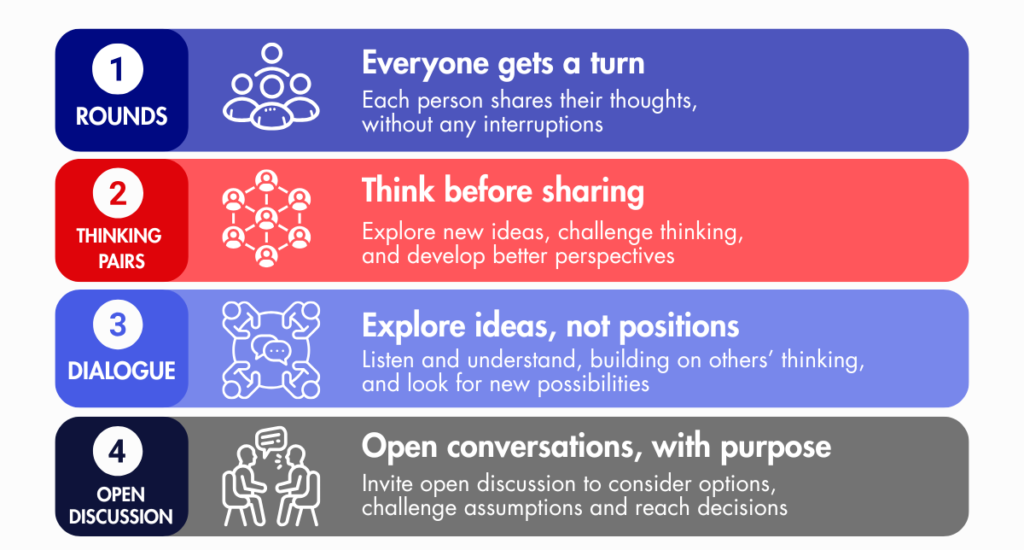
The Thinking Environment framework focuses on creating conditions where people think clearly, independently, and without interruption.
In practice, this means shifting how meetings are run:
• Giving people time to think before responding
• Allowing uninterrupted thinking time rather than constant interjection
• Encouraging equality of voice, rather than defaulting to hierarchy
• Listening with genuine attention rather than preparing a response
• Reducing interruption so thinking can develop fully before discussion moves on
When applied well, this changes the dynamic of a meeting. Contributions become more considered. Ideas are better formed. Decisions are less reactive.
Importantly, it also reduces the “noise” that often clouds decision making in group settings.
Transforming Meetings in Practice
Our Transforming Meetings® Masterclass is designed to address these challenges directly.
Rather than focusing on abstract theory, it explores practical techniques that can be applied immediately to improve how meetings are structured and led.
It examines how to:
- Redesign meetings around purpose rather than habit
- Improve participation and engagement across teams
- Strengthen decision-making processes
- Move conversations from discussion to action
- Apply Thinking Environment principles to improve the quality of group thinking
- Build consistency in follow-through and accountability
The focus is not on making meetings shorter or more frequent, but on making them more effective.
For many teams, even small changes in how meetings are run can create noticeable improvements in clarity, pace and delivery.