


Strong professional judgement is not only about logic. Many poor choices come from emotional decision traps at work: stress that narrows attention, conflict that triggers defensiveness, assumptions that distort intent, and imposter syndrome that undermines confidence. These patterns can affect communication, damage trust, and lead capable people to react rather than respond. Identifying these triggers early and managing them with practical habits that support better decisions under pressure is a highly important skill within the modern workplace.
What emotional decision traps at work look like
Emotional decision traps are recurring patterns where feelings, pressure or mental overload interfere with clear thinking. They do not mean someone lacks professionalism. In most cases, they are normal human responses to uncertainty, deadlines, interpersonal tension or high expectations.
At work, these traps often appear as:
- making rushed decisions when stressed
- reading disagreement as personal criticism
- assuming negative intent without checking facts
- withholding ideas because of self-doubt
- responding defensively to feedback
- struggling to prioritise when mentally overloaded
The impact is rarely limited to one decision. These reactions can reduce collaboration, slow problem-solving and create avoidable friction across teams.
Common patterns that undermine decision-making
Stress and urgency
Under pressure, the brain tends to favour speed over reflection. That can be useful in genuine emergencies, but many workplace situations need a pause rather than an instant reaction. Stress can make people interrupt, skip context, overlook alternatives and communicate too abruptly.
Before replying, pause for a moment, identify the decision that actually needs to be made, and ask: “What are the facts, what is assumed, and what can wait?”
Conflict and defensiveness
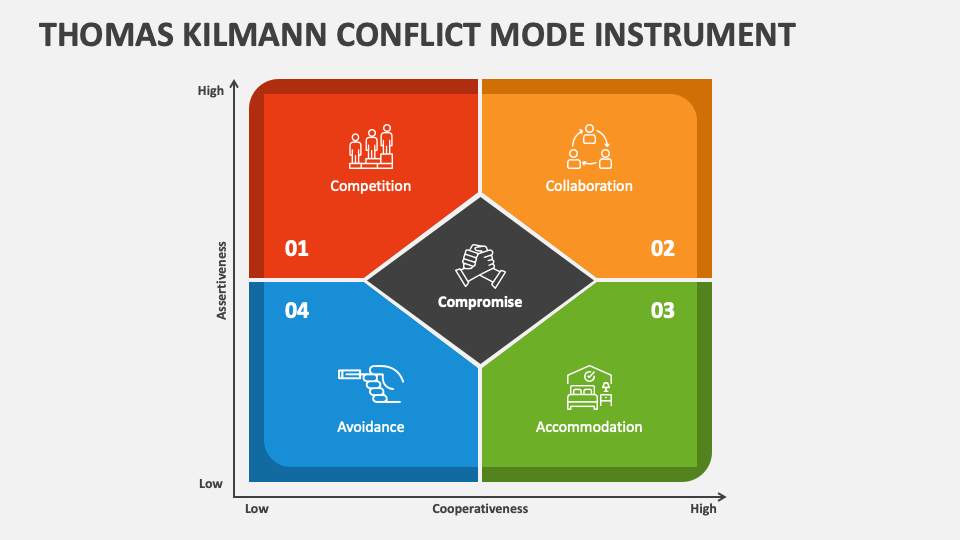
Conflict becomes a decision trap when people focus on winning, protecting status or proving a point instead of solving the issue. Frameworks such as the Thomas-Kilmann Conflict Mode Instrument are useful because they show that people typically lean toward different styles, including avoiding, accommodating, competing, compromising and collaborating.
Recognising your default style can reduce reactive behaviour. For example, someone who avoids conflict may delay important conversations, while someone who competes may escalate tension too quickly. Neither pattern is always wrong, but both can become costly if used automatically.
Assumptions and story-building
Within the workplace, people often fill gaps in information with a story that feels plausible. A delayed reply becomes disengagement. A brief message becomes hostility. A challenge in a meeting becomes disrespect. These assumptions can drive decisions before evidence is checked.
A better approach is perspective taking. Ask clarifying questions, summarise what you think you heard, and separate behaviour from interpretation. This keeps communication grounded and reduces unnecessary escalation.
Imposter syndrome and self-doubt
Imposter syndrome can quietly distort workplace decisions by making capable professionals second-guess themselves, over-prepare, avoid visibility or defer unnecessarily to others. Research on the imposter phenomenon in professional settings highlights how persistent self-doubt can affect wellbeing and performance, even among high achievers.
At work, this may look like not speaking up in meetings, hesitating to lead, or seeking excessive reassurance before acting. The trap is not caution itself. It is allowing self-doubt to replace evidence of competence.
Mental overload and reactive behaviour
When people are cognitively overloaded, they are more likely to default to habits, shortcuts and emotional reactions. This is where sharp emails, poor prioritisation and inconsistent decision-making often appear. Emotional regulation matters here. Research on emotional self-awareness and regulation shows that noticing an emotion early improves the ability to manage its influence on behaviour.
If you cannot think clearly, the next step is to pause to help you reduce noise, define the immediate priority and create structure around the decision.
Practical strategies to respond more effectively
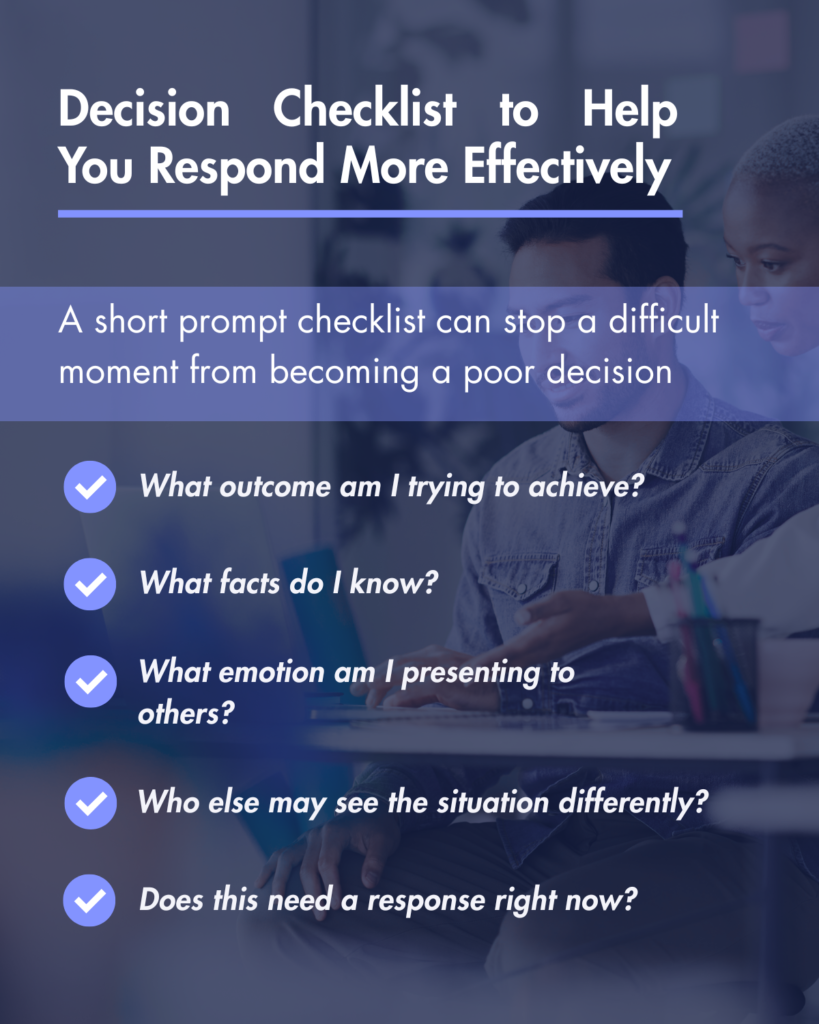
This is especially useful for tense conversations, high-stakes emails and moments of uncertainty.
Build in a breathing reset
Brief breathing resets are practical because they interrupt reactivity without requiring a long break. Before a meeting, after critical feedback or during conflict, pause for one or two slow breaths and relax your jaw and shoulders. The goal is not to remove emotion. It is to regain enough control to choose your next step deliberately.
Practise perspective taking
When emotion rises, ask what else could be true. A colleague may be under pressure rather than dismissive. A manager may be direct rather than dissatisfied. Perspective taking improves communication because it creates room for inquiry before judgement.
Create feedback loops
Trusted feedback helps identify patterns you may not notice on your own. Ask a manager, peer or mentor questions such as: When do I seem most reactive? What do I do well under pressure? Where could I communicate more clearly in conflict? Small feedback loops turn self-awareness into repeatable improvement.
Turning awareness into long-term workplace habits
Recognising patterns is the first step, but sustainable change comes from practice. Techniques such as checklists, breathing resets, perspective taking and feedback loops work best when they are used consistently, not only when things go wrong.
Our Harnessing Emotional Intelligence and Improving Personal Communication Skills course is designed to help professionals practise self-awareness, regulate responses and communicate more effectively in real workplace situations. Rather than treating emotional control as a vague soft skill, it builds practical habits that support better decisions, stronger relationships and more confident performance.
Pam Luo